
Alignment Technology
Technology for adjusting and correcting the alignment of paper during transport while maintaining production print speed
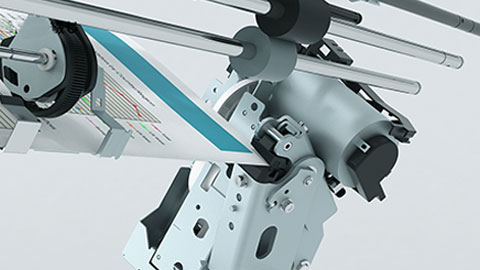
Paper alignment technology comprises two categories.
- Technology to align and transport paper before printing
- Technology to align and transport paper after printing
Media Leading-edge Alignment Technology (Paper Feed Deck)
Paper conveyance technology that achieves both high productivity and high accuracy with various types of paper
The newly developed paper-transport technology uses a transport-belt configuration to support various types of paper. The belt-mounted sphere and alignment plate operate while transporting paper, making it possible to carry out both transport and leading-edge alignment of the paper simultaneously via horizontal and slant feeding. As a result, both high productivity and high precision are realized with stable paper transportation at the same time.
Paper Feed DecksCollating Technology (collating unit)

Collating technology enables precise paper alignment
By adding alignment plates that align the paper on the tray as if it were arranged by hand as well as a paddle unit mechanism that returns the paper in the transport direction to a predetermined position, papers are loaded and stacked in a more precise manner, thereby improving the efficiency of post-packing work.
Staple FinisherStapling Technology
Technology that both prints and staples documents, thereby eliminating subsequent processes
There are various methods of stapling papers, including stapling a large number of sheets with metal needles, multiple staples, saddle stitching, and staple-free stapling. Staple-free stapling is suitable for use in places where safety is paramount, including kindergartens, nursery schools, hospitals, and nursing facilities, as well as in food production facilities and educational institutions. In addition to being safe, this technology is also environmentally friendly. Here, we take a closer look at this paper-stapling technology.
Staple-free Stapling Technology (finisher)

Stapling paper without using metal staples
Staple-free stapling uses Canon’s unique gear-tooth profile that tightly crimps paper and then entangles its fibers, stapling it together without making holes. In response to requests to increase the number of sheets that can be bound using this approach, our R&D efforts have made it possible to staple up to 10 sheets at a time. As a result, over 90% of printouts that previously had to be stapled with metal needles can now be stapled without needles.*
- * According to our internal research
Video Square - Videos
Folding Technology
Technology that enables a variety of folds in one machine
Canon Finetech Nisca offers in-line paper-folding devices for post-processing, including Half Fold, Z-fold, C-fold, accordion-fold, and Double-parallel Fold. Z-fold processing can be used in conjunction with the stapling function of a finisher to staple booklets, while C-fold and accordion-fold processing can be used to seal paper inside envelopes. This large variety of paper-folding functions improves the efficiency of post-processing. This section introduces our paper-folding technology.
Multifunctional folding technology (folding unit)
Various folding functions integrated into space-saving design
Various types of paper folding, including half-fold and Double-parallel Fold, are made possible by the use of three rollers that can turn back and forth with precise paper-position control and alignment calibration.
Paper-folding Unit, Document-insert Device, Perfect BinderVideo Square - Videos